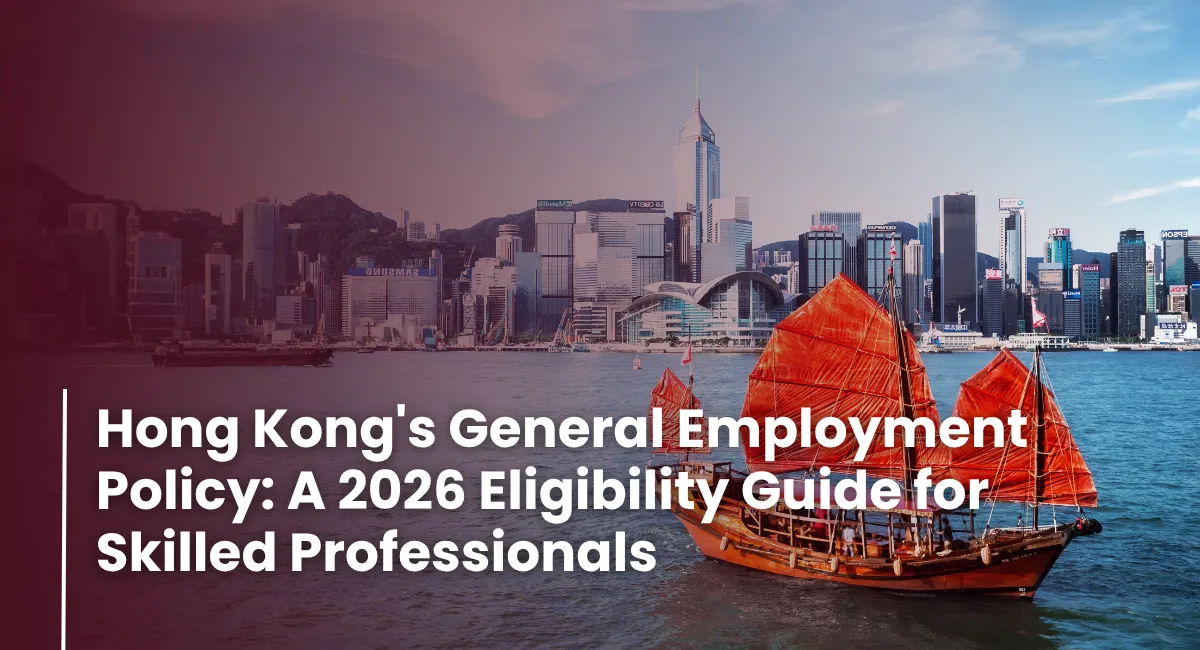
Hong Kong's General Employment Policy: A 2026 Eligibility Guide for Skilled Professionals
August 20, 2026 | Hong Kong Immigration
Hong Kong’s General Employment Policy has been the city’s main door for foreign professionals for decades, and it hasn’t needed a dramatic overhaul to stay relevant. What has changed heading into 2026 is the fee structure applicants now pay and the pace at which the Immigration Department is refreshing its guidance — the official GEP page itself carries an April 2026 update. None of that has touched the core eligibility test, but it does mean a few numbers and procedural details that circulated in older blog posts and forum threads are now out of date.
That’s the trap for anyone researching this route online: the eligibility criteria have been stable for years, but the fees, extension patterns, and supporting documentation get tweaked more often than people expect, and a lot of what’s indexed on Google was written before the current rules took effect. This guide works from Hong Kong’s Immigration Department’s own published criteria, so you’re starting from what’s actually current rather than what used to be true.
Would you like us to check your eligibility for Hong Kong Immigration?
Please get in touch with us and our experts will guide you!
What the General Employment Policy Actually Is
The General Employment Policy, usually shortened to GEP, is Hong Kong’s principal employment-based visa route for professionals who aren’t Mainland Chinese residents. It’s quota-free and not restricted to any particular industry, which sets it apart from schemes that cap admissions by sector or by year. If you’re a foreign national with a confirmed job offer in Hong Kong and the right professional background, GEP is very likely the route your employer will use to sponsor you.
Two groups fall outside standard GEP and use different arrangements instead. Mainland Chinese residents apply through the Admission Scheme for Mainland Talents and Professionals, a parallel scheme with similar aims. And nationals of a small number of countries — currently Afghanistan, Cuba, and North Korea — are excluded from this particular entry arrangement altogether. There’s also a Technical Professionals Stream sitting under the GEP umbrella, aimed at experienced non-degree tradespeople aged 18 to 40 in sectors facing acute skills shortages; that stream is quota-limited and sits apart from the main GEP criteria described below.

Eligibility Criteria for 2026
The Immigration Department assesses every GEP application against five published criteria. Applicants need to satisfy all of them, not just the majority:
A clean record
No security objection and no known record of serious crime.
A relevant education or professional background
Normally a first degree in a field relevant to the role, though the Department will accept strong technical qualifications, proven professional ability, or substantial relevant experience in place of a degree where the case is well documented.
A genuine vacancy
The job itself has to be real — not a role created to justify the visa application.
A confirmed job offer that fits the applicant's profile
The position needs to connect logically to the applicant’s qualifications or experience, and it needs to be work that can’t be readily filled by someone already in Hong Kong’s local workforce.
Market-rate compensation
The full remuneration package — salary, accommodation, medical benefits, and other perks — has to be broadly in line with what similar professionals earn in Hong Kong. Applications with salaries that look deliberately low for the role are a common reason for refusal.
Meeting these five criteria doesn’t guarantee approval. The Director of Immigration retains full discretion over every application, and each case is judged on its individual facts.
Investment-Linked Routes vs. Employment-Sponsored Entry
It’s worth being clear about what GEP is and isn’t, especially if you’ve also been looking at Hong Kong’s capital-linked entry schemes. GEP is built entirely around employment — a genuine job with a genuine employer. If your interest in Hong Kong is more about establishing a business presence or making a qualifying capital investment rather than taking up salaried employment, that’s a different conversation with a different set of criteria, and it’s worth discussing both paths with an advisor before you commit to one.
The Application Process
- Secure a confirmed job offer. GEP applications flow from the employment relationship, so this has to be in place first, with a written contract or letter of appointment setting out the position, salary, and benefits.
- Assemble supporting documents. Both the applicant and the sponsoring employer submit separate sets of documents (detailed below).
- Submit the application online. Applications go through Hong Kong’s official application channel, with all documents uploaded and the application fee paid before the Department will begin processing.
- Processing. The Immigration Department states that GEP applications normally take about four weeks once every required document and the application fee have been received — but it won’t start the clock until the file is complete, so an incomplete submission is the most common cause of delay.
- Visa issuance. Approved applicants receive an e-Visa after paying the visa issuance fee, which they present on arrival in Hong Kong along with their travel document.
Documents You'll Need
For the applicant:
- A recent photograph
- A valid travel document
- Hong Kong ID card, if already held
- Proof of academic qualifications and relevant work experience
For the sponsoring employer:
- The signed employment contract or letter of appointment, showing position, salary, benefits, and employment period
- The company’s Business Registration Certificate
- Proof of financial standing, such as an audited financial report or tax return
- Background information on the company’s operations, and — for companies set up within the past 12 months — a detailed business plan
Some of these requirements are waived under the Department’s facilitation measures for applicants or employers who meet certain established criteria, so not every file needs every document. Any document not already in Chinese or English needs a certified translation.
Fees to Budget For
Hong Kong restructured its visa fees for talent and employment-based schemes in early 2025, and the current structure is still what applies going into 2026. Applicants under GEP and similar specified schemes pay a non-refundable application fee, plus a separate visa issuance fee once approved. The issuance fee is tiered by the length of stay granted — a lower rate for stays of 180 days or under, a higher rate for anything longer. Since GEP’s initial grant is normally three years, most successful applicants land in the higher issuance tier. Given how often fee schedules get revised, confirm the exact current figures on the Immigration Department’s fee table before budgeting, rather than relying on a number quoted in an older article.
Length of Stay and Extensions
Successful GEP applicants are normally granted an initial stay of 36 months on employment conditions, or for the length of the employment contract if that’s shorter. Extensions can be applied for within three months of the limit of stay expiring, and the Department recommends submitting at least six weeks before expiry to avoid any gap. Extensions are generally granted in a three-year, then two-year pattern, again conditioned on continuing to meet GEP’s eligibility criteria and on the terms of the employment contract.
There’s also a top-tier employment stream for professionals who’ve been on GEP for at least two years and had an assessable income for salaries tax of at least HK$2 million in the prior tax year. Meeting both conditions can lead to a five-year extension on time limitation only, without the usual employment condition attached — meaning more flexibility to change jobs without seeking fresh approval each time.
After seven years of continuous ordinary residence in Hong Kong, GEP entrants become eligible to apply for the right of abode, Hong Kong’s version of permanent residency.
Bringing Family Members
GEP entrants can sponsor a spouse (including certain legally recognized civil partnerships) and unmarried dependent children under 18 to join them in Hong Kong. Approval depends on proof of a genuine relationship, a clean record for the dependant, and evidence that the sponsor can support them at a standard well above subsistence level with suitable accommodation. Dependants admitted this way are not barred from working or studying in Hong Kong under current policy, and their length of stay is generally tied to the sponsor’s.
What Tends to Go Wrong
Most GEP refusals trace back to one of a handful of recurring issues: a salary package that doesn’t hold up against market benchmarks for the role, a mismatch between the applicant’s qualifications and the position being offered, an employer that can’t adequately document its financial standing or business activity, or a documentation set submitted piecemeal rather than complete from the start. None of these are exotic problems, but they’re exactly the kind of thing that’s easy to get wrong without someone reviewing the file who does this regularly.
What This Means If You're Comparing Programs
The General Employment Policy rewards a well-prepared file — accurate documentation, a defensible salary benchmark, and an employer submission that holds up to scrutiny. Fee structures and procedural details shift more often than the headline eligibility criteria, which is exactly where outdated online guidance leads people astray.
Simard & Associates advises skilled professionals and their sponsoring employers through every stage of the Hong Kong General Employment Policy application, from assessing eligibility to preparing a complete, current submission. If you’re planning a move to Hong Kong in 2026, get in touch for a personalized consultation before you file.

Why you should choose Simard & Associates as your Immigration Lawyer?
Global mobility decisions deserve thoughtful analysis. If you’d like to explore your options further, our team can provide structured, expert guidance based on current policy and your long‑term objectives.
At Simard & Associates, we bring expertise, dedication, and a personalized approach to every immigration case. With a proven track record of success, we guide you through the complexities of immigration law with confidence and care. Our team is committed to providing tailored solutions, ensuring your application process is smooth, efficient, and stress-free. Whether you’re pursuing residency, citizenship, or visas, Simard & Associates is your trusted partner for achieving your immigration goals.

For more details & questions, Kindly contact us and one of our Immigration Consultant & Immigration Lawyers will respond to you.
Latest Immigration News
- All Posts
- Immigration News
- Latest News
- 最新动态
- 最新動態
- 未分类
- 未分類
- 移民新聞
- 移民新闻

Share this post:
GET IN TOUCH WITH US
Simard & Associates helps clients apply for citizenship and residence under the applicable programs. To schedule an initial free consultation, get in touch with us.
GET IN TOUCH WITH US
Simard & Associates helps clients apply for citizenship and residence under the applicable programs. To schedule an initial free consultation, get in touch with us.
